OOH Advertising Strategy: Why Location Is the Real Media Plan
Out-of-home (OOH) advertising is back in a big way—not because it’s “old school,” but because it reaches people when they’re living real life: commuting, shopping, meeting, and moving through public spaces. That real-world presence is also why OOH has become more measurable and more strategic, especially as Digital Out of Home (DOOH) expands and planning becomes more data-led.
At an industry level, the direction is clear: the World Out of Home Organization (WOO) reports global OOH spend reached $46.2B in 2024, with a forecast of $49.8B in 2025. It also reports DOOH spend at $17.9B in 2024, representing almost 39% of all OOH revenues—a strong indicator that the channel’s growth is tied to digitization and smarter planning, not just “more billboards.”
The simplest truth about OOH: location is the strategy
In digital media, targeting is often built around user identities and behaviors. In outdoor advertising, targeting is built around context: where people are, what they’re doing, how long they’re there, and what mindset they’re in.
That’s why strong OOH planning starts by treating “location” as the real media plan. A screen isn’t valuable because it’s large—it’s valuable because it sits inside a predictable human routine. When a placement aligns with a repeated route, a high-intent environment, or a high-dwell moment, you don’t just buy visibility—you buy relevance.
A practical planning framework (without overcomplicating it)
If you want OOH to perform, plan it like a portfolio—not a shopping list. Here’s a clean framework most teams can apply immediately:
Start with the business outcome. Are you trying to build awareness for a launch, strengthen consideration, drive store visits, or support a promotion? The objective decides everything that follows: the environments you prioritize, the formats you choose, and how you’ll measure success.
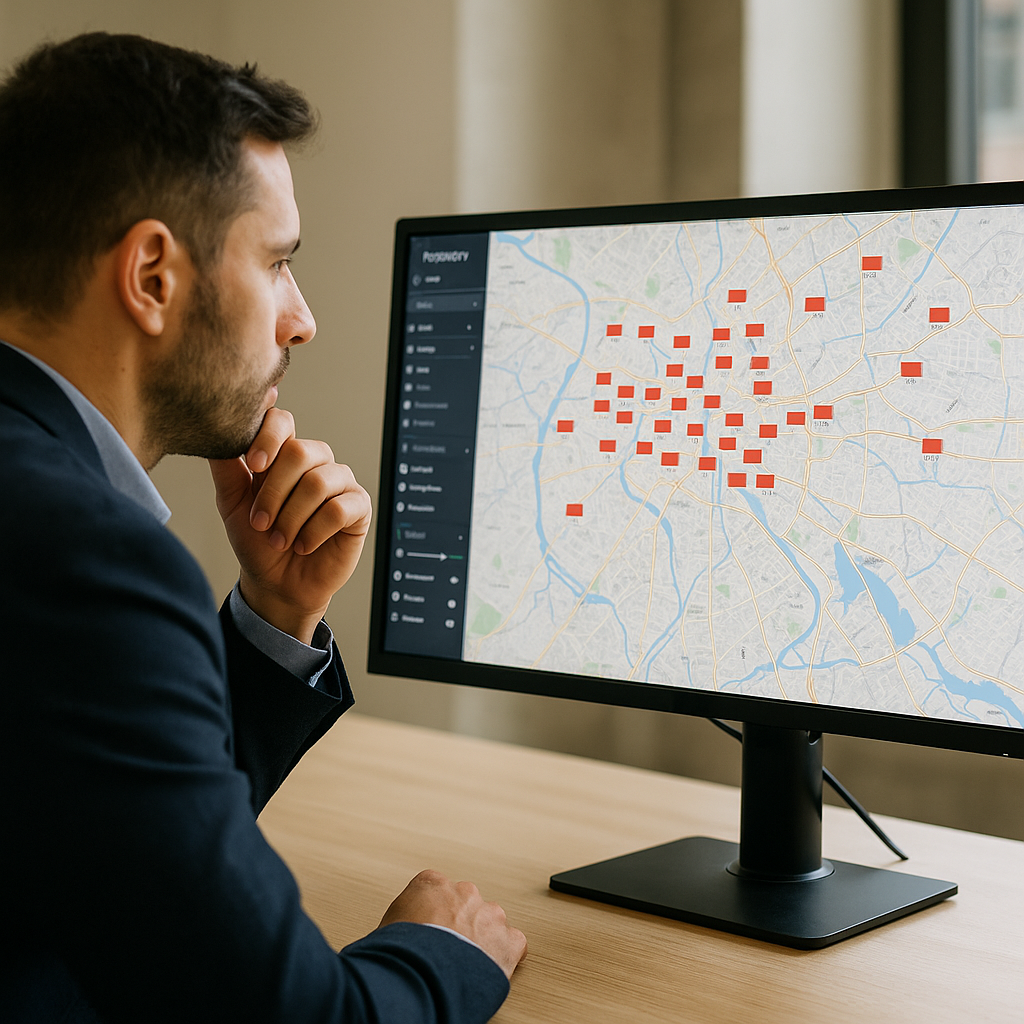
Then plan in clusters (zones), not one-off sites. Instead of picking individual screens in isolation, group inventory into meaningful “zones” like commuting corridors, retail clusters, leisure districts, or transit hubs—because that’s how audiences actually move. This also makes it easier to optimize later: you can shift weight from one zone to another instead of endlessly swapping single placements.
Next, match the format to the viewing behavior. Not all screens are equal, even when impression estimates look similar. Fast-moving roadside exposure demands ultra-simple creative and high legibility. High-dwell environments (like transit stations or indoor networks) allow for more storytelling, product education, and sequential messaging.
Finally, make measurement part of the plan from day one. The point isn’t to “prove OOH works” after the fact—the point is to define what “working” means before you launch.
Measurement: what to track so OOH becomes accountable
OOH has historically been viewed as hard to measure, but that’s changing. Nielsen’s Brand Impact example demonstrates that OOH can be linked to brand outcomes like awareness and purchase intent, including reported improvements such as +1.9% purchase intent and +4.0% unaided awareness in an OOH-heavy campaign comparison.
In practice, measurement usually combines a few layers:
- Delivery confirmation (proof of posting / play logs for DOOH)
- Reach and frequency modeling where available
- Brand lift studies
- Outcome signals like footfall or sales correlation when appropriate and privacy-safe.
The biggest upgrade you can make is simply this: don’t treat reporting as a “wrap-up deck.” Treat it as feedback that informs what you buy next.
Creative that works outdoors (and why most OOH underperforms)
OOH creative succeeds when it respects the environment. People don’t stop and “read” outdoor ads—they notice them while doing something else. That means clarity beats complexity almost every time. One message per execution, strong contrast, minimal copy, and a visual hierarchy that works in a glance.
DOOH adds an extra advantage: you can run different creative by time of day, rotate messages, and sequence storytelling across multiple placements—when the network and rules allow it.
Where OOH fits in a modern media mix
OOH plays especially well when you need broad mental availability and cross-channel amplification. It can create demand that shows up later as search lift, social engagement, store visits, or improved conversion performance across other channels. And because it’s anchored in public spaces, it can complement digital rather than compete with it.